Every scout has seen it: a player who looked outstanding at his last club arrives and disappears. Nothing changed in his ability. What changed was the context — the role, the game model, the players around him. That is why I don't start a scouting process with a player. I start with the fit.
Filter 1 — The role
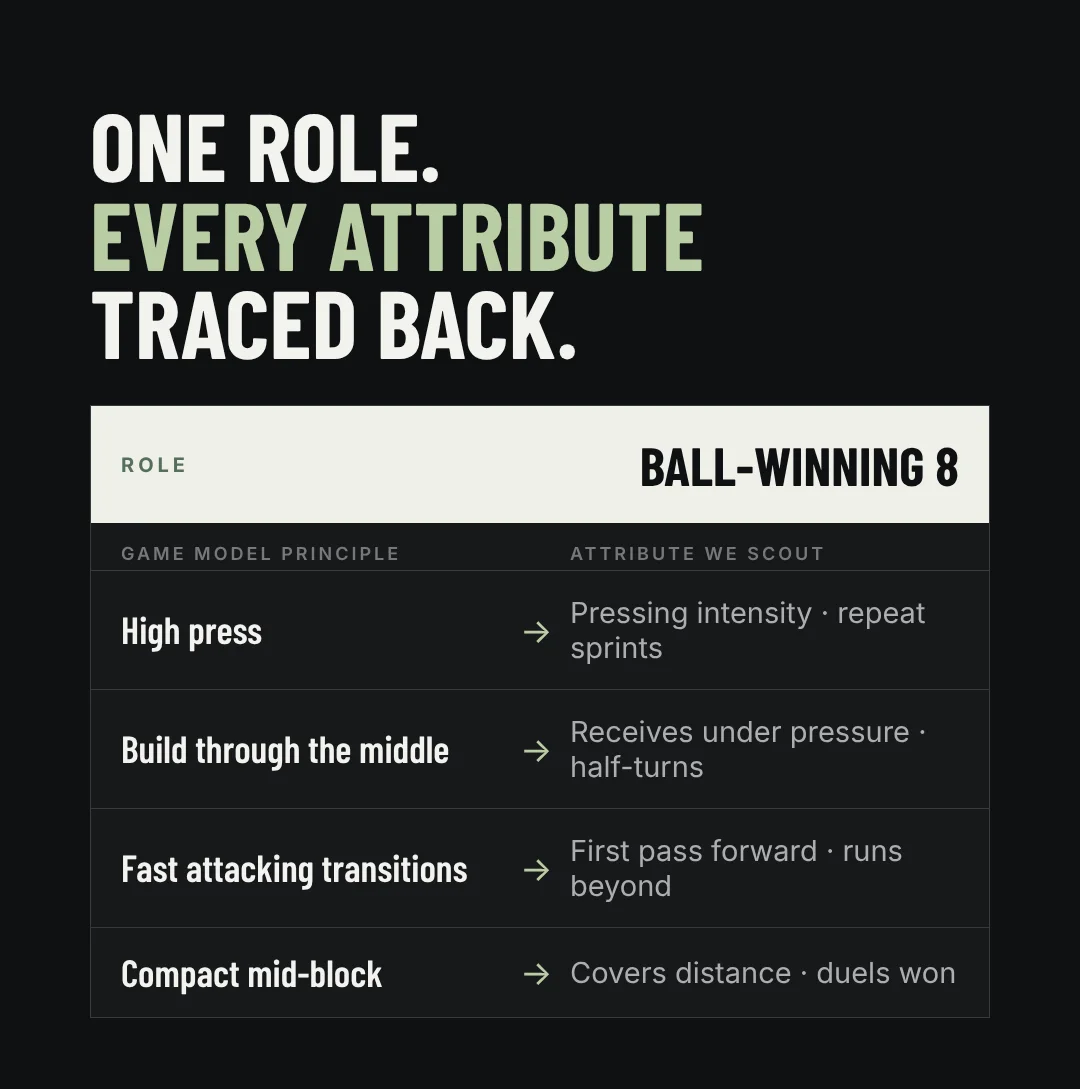
Not "a midfielder", but the exact job: a ball-winning eight who presses forward, or a deep playmaker who receives between the centre-backs. The more precise the role, the shorter and better the list.
Filter 2 — The game model
Every attribute should trace back to how the team wants to play. If the coach wants a high press, the player's work rate and pressing intensity matter more than his passing range. If the team builds through the middle, receiving under pressure becomes non-negotiable.
Filter 3 — Data to narrow the list
Data is the fastest way to remove players who don't fit and to find ones nobody is watching. It tells you where to look. It doesn't tell you what you are looking at.
Filter 4 — Video to confirm
Video shows the context behind the numbers: the decisions, the body shape, the movement without the ball, and how the player behaves when the game goes against him. Full matches, not highlights.
Filter 5 — The person
Character, adaptability and how a player will handle a new country, language and dressing room. Often it is the last filter, and often it is the one that decides.
Order matters. Each filter narrows the list and gives the next one something solid to work with. Skip the role and the game model, and the data has nothing to measure against.