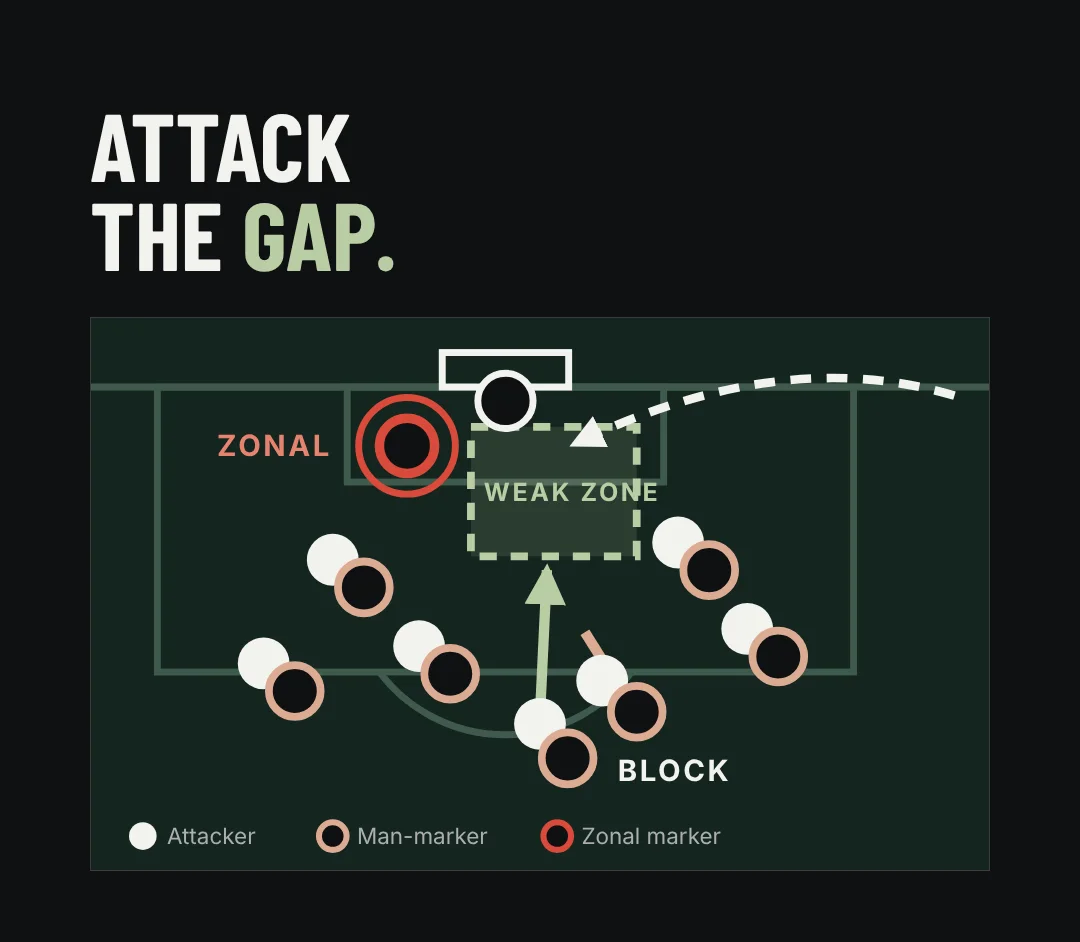
No defensive corner system is perfect. Zonal markers protect space, man-markers protect people — and somewhere between the two there is always a gap. Finding that gap is one of the most valuable things a set-piece analyst can give a coaching staff, because set pieces are the only moments in a match you can fully rehearse.
Step 1 — Count the zonal markers
Start with the shape. How many players defend space, and where do they stand? One at the front post, two across the six-yard box, five in a line? The number of zonal players tells you how many man-markers are left, and usually who they are.
Step 2 — Find the space nobody owns
With one front-post zone, the centre of the six-yard box is often unprotected. With a full zonal line, the space in front of the line and around the penalty spot is attacked by players arriving with momentum, while the zonal defenders are standing still. In hybrid systems, the weakest point is often where a zonal defender and a man-marker both think the other one has the ball.
Step 3 — Design the delivery and the block
Once the weak zone is clear, the routine builds itself: the delivery that reaches it, the runner who attacks it, and the block or screen that stops the nearest defender from getting there first. Blocking is the reason man-marking systems struggle — a man-marker who is blocked has nobody behind him.
Video before theory
I always confirm the weak zone with video from their recent matches. If they have conceded from the same area twice, it is no longer a theory — it is a plan. That is what I bring to the staff: the zone, the evidence, and the routine to attack it.