Most opposition reports fail for the same reason: they describe everything and explain nothing. Forty slides of formations, heat maps and pass networks, and the coaching staff still walks out of the meeting without knowing how to win the game.
Before I open the video, I start with four questions. If the report cannot answer them clearly, it is not finished — no matter how many pages it has.
1. How do they build?
Where does the first pass go from a goal kick or a centre-back, and who is free to receive it? Some teams always look for the full-back, some drop a midfielder between the centre-backs, some go long to a target man. Once you know the first pass, you know where to set your press.
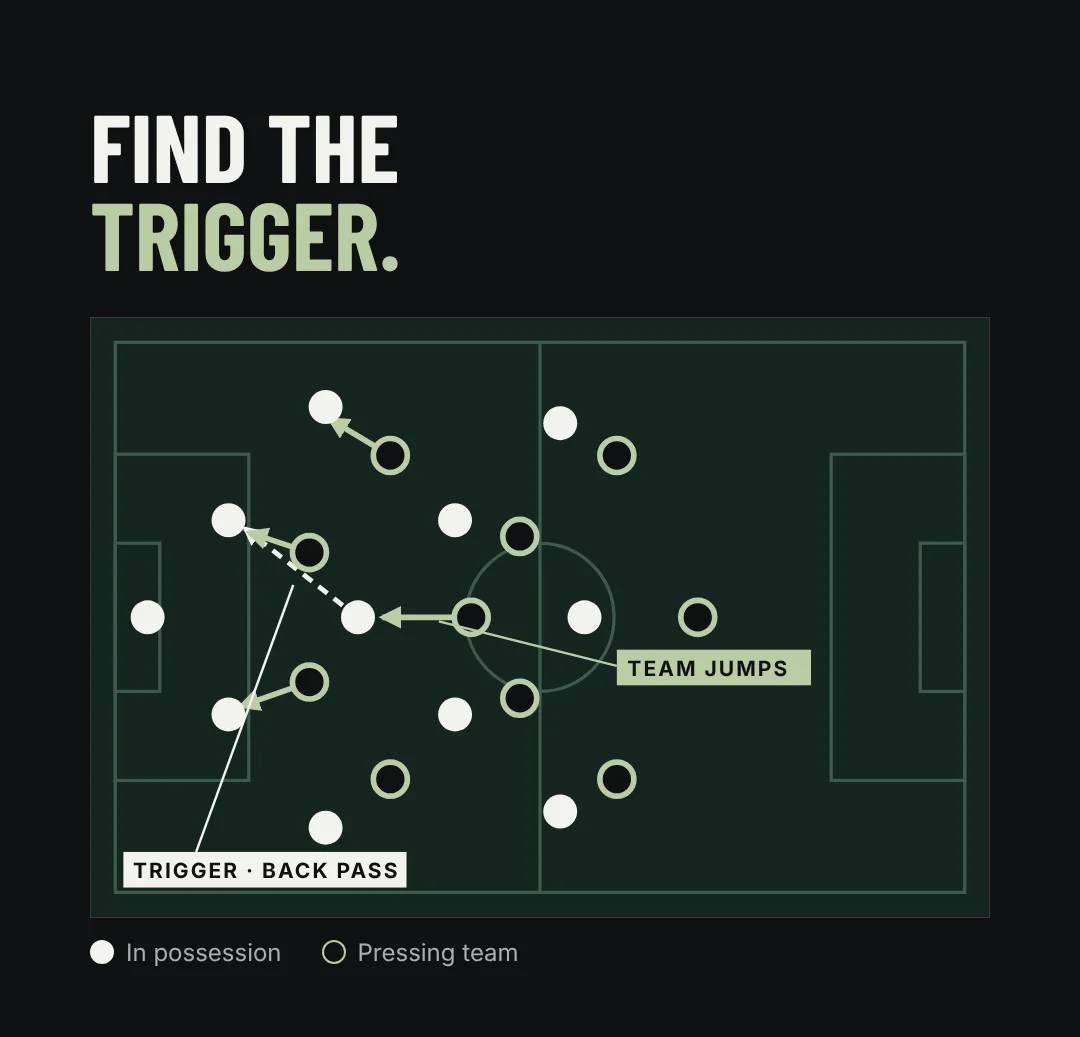
2. Where do they press — and what triggers it?
Every press has a trigger: a back pass, a poor first touch, a ball played into the full-back near the touchline. Find the trigger and you can either avoid it or use it to draw them forward and play into the space they leave behind.
3. What happens in the five seconds after they lose the ball?
Transitions decide more games than shape does. Do they counter-press or retreat? How many players stay behind the ball when they attack? The answer tells you where the space will be when you win it back.
4. What do they do on set pieces?
Set pieces are the most rehearsed moments of their week, which makes them the most predictable. Delivery type, target zones, blocks, who attacks the ball, and the defensive system — zonal, man or hybrid — and where it is weak.
From report to team talk
Answering the four questions is the analyst's work. The players should see the result, not the process: three messages and a handful of clips. If a player can repeat the three messages before kick-off, the analysis has done its job.